Ring / tube magnets are one of the six published sintered neodymium shape families on this site. The figures on this page belong to this shape only. They are reproduced from the company's shape page for ring / tube magnets, and they must not be carried over to another shape family, where a different size table applies. If your drawing calls for a dimension outside the range below, do not round it into the range: ask whether it can be made, and send the drawing dimension as written.
Send your magnet specification for reviewCompare shape ranges
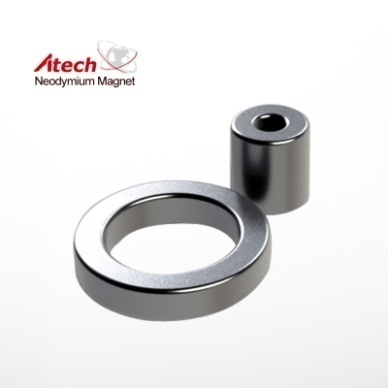
Published size, tolerance and magnetization range for this shape
| Item | Published range |
|---|---|
| Outer Diameter | Min. 3.0 mm — Max. 200 mm |
| Inner Diameter | Min. 1.5 mm — Max. 150 mm |
| Height | Min. 0.5 mm — Max. 50 mm |
| Tolerance | Standard ±0.05 mm, Min. ±0.01 mm |
| Magnetization directions listed for this shape | Axial, Diametrical, Radial |
Reading this shape's range
A published range states a minimum and a maximum, not a stocked size list. A value between the minimum and the maximum still needs to be confirmed as a makeable size for the grade series and magnetization direction you need, because the range table does not, by itself, promise every intermediate size in every grade. The tolerance line works the same way: a standard tolerance and a minimum tolerance are both published for this shape, and the inquiry should state which tolerance the drawing requires rather than leaving it to assumption. Where a dimension is listed as customized, as it is for parts of the arc and countersunk ranges, there is no published minimum or maximum to quote, and the dimension must be supplied by the buyer.
A ring or tube is defined by three figures: outer diameter, inner diameter and height. The inner diameter is what distinguishes this shape from a disc, and it must be stated explicitly: a ring inquiry without an inner diameter is, in effect, a disc inquiry, and the two will not be confused if the inner figure is present. Radial magnetization is listed for this shape, and it is one of the directions that buyers most often need to describe carefully, because radial and diametrical are different arrangements even though both involve the diameter. Copy the listed term exactly, and add a plain-words note if your drawing uses another convention.
Grade temperature table (shared table)
The table below is the shared grade maximum working temperature table carried on each of the company's shape pages. It is reproduced here in full so that this page can be read on its own, but it is not a measurement for this shape alone, and it must not be quoted as if it were. Grade names beyond the temperature row are not expanded into performance claims on this site.
| Grade series | Maximum working temperature |
|---|---|
| N35–N52 | 80°C (176°F) |
| 33M–48M | 100°C (212°F) |
| 33H–48H | 120°C (248°F) |
| 30SH–45SH | 150°C (302°F) |
| 30UH–40UH | 180°C (356°F) |
| 28EH–38EH | 200°C (392°F) |
Magnetization directions for this shape
The magnetization directions listed for this shape are: Axial, Diametrical, Radial. Direction words are meaningful only inside the shape they belong to. The same word can describe a different physical arrangement on a different shape, which is why this site never publishes a direction list without naming the shape it belongs to. When you write an inquiry, copy the direction exactly as listed for this shape, and add a sketch or a direction note if the drawing uses a different convention, so the review can reconcile the two without guessing.
If the direction you need is not listed for this shape, that is a question to ask, not a detail to improvise. Some buyers arrive with a direction term from another shape family or from another material, and the safest response is to state the required direction in plain words alongside the listed term, so the supplier can confirm whether the listed term covers it. A direction that is assumed rather than confirmed is a common source of a magnet that is dimensionally correct and magnetically wrong for its fixing.
What to confirm before ordering this shape
Send the shape name, the dimensions inside this shape's published range, the grade temperature series, and the magnetization direction exactly as listed. State the operating temperature and the fixing arrangement where they affect the choice. Please confirm coating requirements before ordering, because coating type names were not transcribed from the company's illustration and no coating type is named on this site. Please confirm minimum order quantity and lead time before ordering. Warranty terms are unavailable on the published pages — please confirm warranty terms before ordering. Certificates are available upon request; no certificate number or issuing body is published here.